
Warehouse Management System Dubai: The Ultimate Guide to Smarter, Faster, and More Profitable Inventory Control
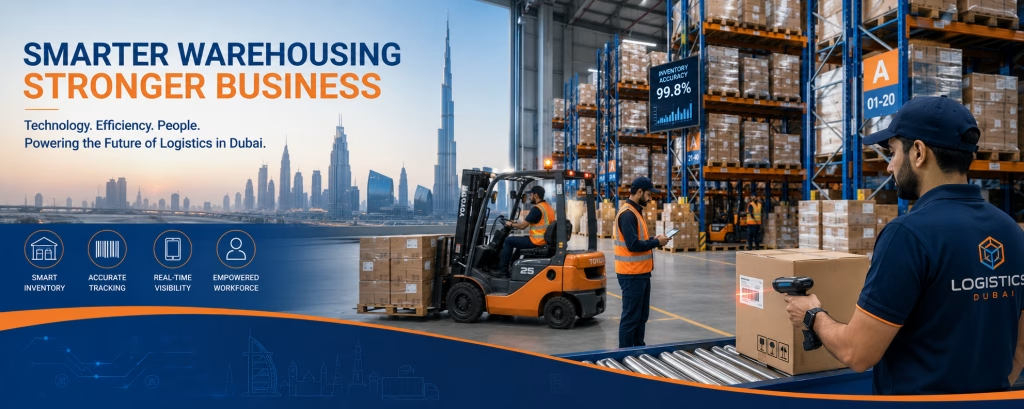
A warehouse management system Dubai businesses rely on is no longer a luxury — it is the backbone of every competitive supply chain operation in the UAE. Whether you run a retail distribution centre in Al Quoz, a cold-chain facility in Jebel Ali, or a growing e-commerce fulfillment hub in Dubai Investments Park, the pressure to move goods faster, reduce errors, and cut operational costs has never been higher.
This comprehensive guide from Alsantrade walks you through everything you need to know about choosing, implementing, and maximizing a warehouse management system in Dubai — including the top features to look for, the real ROI your business can expect, and why Dubai’s unique logistics landscape demands a purpose-built solution.
What Is a Warehouse Management System and Why Does Dubai Need One?
A warehouse management system (WMS) is a software platform designed to control and optimize the day-to-day operations of a warehouse — from the moment goods arrive at your dock door to the second they leave for final delivery.
But here is the thing: not every WMS is built for the pace and complexity of Dubai’s market.
Dubai sits at the crossroads of global trade. The emirate handles over 14 million tonnes of cargo annually through Dubai International Airport alone, and Jebel Ali Port is the largest container port in the Middle East. Businesses operating in this environment face unique challenges — multi-currency transactions, Arabic and English bilingual operations, extreme seasonal demand spikes during Ramadan and the Dubai Shopping Festival, and strict customs compliance requirements for cross-border goods moving through free zones.
A generic, off-the-shelf WMS simply cannot handle all of this. A warehouse management system Dubai businesses use must be tailored to these conditions.
Key Signs Your Dubai Business Needs a Warehouse Management System Right Now
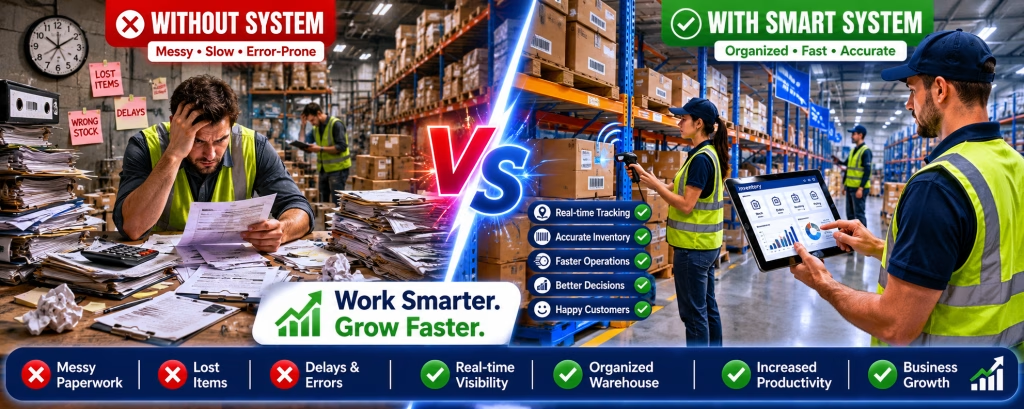
Before we go deeper, here are the unmistakable warning signs that your current warehouse operation is costing you money every single day:
You are still using spreadsheets or paper-based systems. Every manual entry is a potential error. Every error is a potential lost order, an angry customer, or a compliance failure.
Your inventory accuracy is below 98%. Industry best practice for a healthy warehouse is 98–99% inventory accuracy. If you do not know your number, that is already a red flag.
Your team spends more than 20% of their time searching for items. Poor slotting and lack of real-time visibility turn your warehouse floor into a treasure hunt — and time is money.
You experience regular stockouts or overstock situations. Both are expensive. Stockouts lose you sales. Overstock ties up capital and increases holding costs.
Your order picking errors are above 1%. The industry benchmark for best-in-class operations is fewer than 1 error per 1,000 picks. Manual systems rarely achieve this.
You cannot provide real-time shipment visibility to your customers. In the age of same-day and next-day delivery expectations, this is a serious competitive disadvantage.
If two or more of these apply to your operation, a warehouse management system Dubai solution from Alsantrade is exactly what your business needs.
Top Features to Look for in a Warehouse Management System in Dubai
Not all systems are created equal. Here are the non-negotiable features any serious warehouse management system Dubai platform must offer:
1. Real-Time Inventory Tracking
Your WMS should give you a live, accurate view of every SKU — its exact location in the warehouse, how many units are available, how many are reserved for open orders, and what is on the way from suppliers. Real-time tracking eliminates the guesswork that drives costly errors.
2. Barcode and RFID Integration
Manual data entry is the enemy of accuracy. A strong warehouse management system Dubai solution integrates seamlessly with barcode scanners and RFID technology, allowing your team to receive, pick, pack, and ship with near-zero errors.
3. Multi-Location and Multi-Warehouse Support
Many Dubai businesses operate across multiple free zones — Jebel Ali Free Zone (JAFZA), Dubai Multi Commodities Centre (DMCC), Dubai Airport Free Zone (DAFZA), and more. Your WMS must handle inventory visibility and transfers across all locations from a single dashboard.
4. Arabic Language and AED Currency Support
This is critical and often overlooked. A warehouse management system in Dubai must support bilingual operation in Arabic and English, and handle AED pricing, VAT compliance, and UAE-specific financial reporting requirements out of the box.
5. VAT and Customs Compliance
Since VAT was introduced in the UAE in 2018, every inventory transaction must be accurately recorded for tax reporting. Your WMS should integrate with your accounting system to auto-generate VAT-compliant documentation, including delivery notes, goods receipts, and tax invoices.
6. Order Management and Wave Picking
For businesses handling high order volumes — especially e-commerce sellers and 3PL providers — wave picking and batch picking capabilities can cut pick time by up to 40%. The system should intelligently group orders, assign tasks to pickers, and optimize walking routes on the warehouse floor.
7. Returns Management (Reverse Logistics)
Returns are a major cost centre for Dubai retailers, particularly those selling through Noon, Amazon UAE, and their own online stores. Your WMS should streamline the returns process — inspecting, restocking, or flagging items for disposal with minimal manual intervention.
8. Integration with ERP and E-Commerce Platforms
A WMS that lives in isolation is only half useful. Look for seamless integration with your ERP (SAP, Oracle, Microsoft Dynamics), your e-commerce storefronts (Shopify, Magento, WooCommerce), and UAE-specific marketplaces like Noon and Amazon UAE.
9. Mobile and Cloud Accessibility
Your warehouse manager should be able to check inventory levels from their phone at 11 PM before a major sale event. A cloud-based warehouse management system in Dubai gives your leadership team real-time visibility from anywhere, on any device.
10. Advanced Reporting and Analytics
The best WMS platforms give you KPI dashboards covering order cycle time, pick accuracy, dock-to-stock time, inventory turnover, and labour productivity. Data-driven decision making is what separates great warehouse operations from average ones.
Industries in Dubai That Benefit Most from a Warehouse Management System
A warehouse management system Dubai solution creates measurable value across virtually every sector. These are the industries seeing the highest ROI from WMS implementations right now:
Retail and Fashion
Dubai’s retail sector is one of the most sophisticated in the world. From flagship stores in Dubai Mall to multi-brand online stores shipping across the GCC, retail businesses need precise inventory control, season-based demand planning, and seamless omnichannel fulfilment.
Food and Beverage (FMCG)
Temperature-controlled warehousing, FIFO (First In, First Out) stock rotation, expiry date tracking, and batch traceability are non-negotiables for food businesses. A purpose-built WMS handles all of this automatically.
Construction and Building Materials
Large, heavy, and varied construction materials require bin location management, weight-based inventory tracking, and careful load planning. A WMS tailored for this sector can dramatically cut material waste and project delays.
Healthcare and Pharmaceuticals
Regulated industries like pharma require end-to-end traceability, lot number management, controlled substance tracking, and compliance with UAE Ministry of Health regulations. A robust warehouse management system Dubai solution in this space is not optional — it is a legal requirement.
E-Commerce and Fulfilment
Dubai’s e-commerce sector is growing at over 23% annually. Fulfillment accuracy, same-day dispatch capability, and seamless marketplace integration are the competitive battleground for e-commerce businesses. A WMS is the engine that makes it all possible.
Logistics and 3PL Providers
Third-party logistics providers managing inventory for multiple clients need multi-client WMS functionality, individual client billing, and real-time reporting portals that clients can access directly.
The Real ROI of Implementing a Warehouse Management System in Dubai
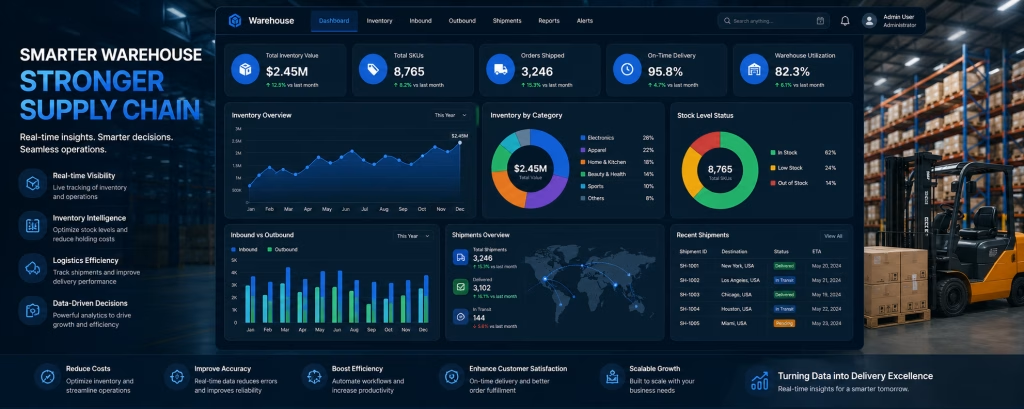
Let us talk numbers, because that is what matters to business owners and CFOs.
Businesses that implement a quality warehouse management system typically report the following improvements within the first 12 months:
Inventory accuracy improves from an average of 65–75% to 98–99%. This alone eliminates write-offs, reduces emergency purchases, and frees up working capital.
Order picking productivity increases by 20–40%. Better slotting, guided picking paths, and elimination of manual paperwork mean your team picks more orders in less time.
Order error rates drop by up to 67%. Fewer returns, fewer customer complaints, fewer write-offs, and stronger customer retention.
Storage space utilization improves by 10–25%. Smart slotting and bin optimization mean you get more inventory into the same footprint — delaying the need for costly warehouse expansion.
Labour costs reduce by 15–30% over two years. Not by cutting jobs, but by eliminating wasted motion, reducing overtime caused by errors, and enabling your team to process more orders without adding headcount.
For a mid-sized Dubai warehouse processing 200–500 orders per day, these gains typically translate into AED 500,000 to AED 2,000,000 in annual savings.
How to Choose the Right Warehouse Management System in Dubai: A Step-by-Step Framework
Choosing the wrong WMS is an expensive mistake. Here is the framework Alsantrade recommends to every client before they make a decision:
Step 1: Map Your Current Warehouse Processes
Before you evaluate any software, document every process in your warehouse — receiving, put-away, storage, picking, packing, dispatch, returns. Identify your three biggest pain points. Any WMS you evaluate must solve those pain points directly.
Step 2: Define Your Integration Requirements
List every system your WMS must talk to — your ERP, your accounting software, your e-commerce platforms, your carrier and freight partners. Integration failure is the number one reason WMS implementations go over budget.
Step 3: Evaluate Scalability
Your warehouse operation will grow. The WMS you choose today must handle three to five times your current order volume without requiring a complete platform replacement. Ask every vendor specifically about their largest UAE client and what volumes they process.
Step 4: Insist on a Dubai-Based Implementation Team
A warehouse management system Dubai implementation is not just a software installation — it is a business transformation project. You need a team that understands UAE business culture, speaks Arabic if needed, can be on-site in Dubai within hours when things go wrong, and understands local compliance requirements.
Step 5: Demand a Proof of Concept
Any reputable WMS provider will offer a pilot or proof-of-concept phase. Insist on running the system in a controlled section of your warehouse for 30–60 days before full rollout. This surfaces integration problems, usability issues, and gaps in functionality before they become expensive problems.
Step 6: Evaluate Total Cost of Ownership
Do not just compare licence fees. Calculate the total cost of ownership over five years — including implementation, training, customization, integration, ongoing support, and upgrade fees. Many cheap WMS solutions become very expensive once you factor in the full picture.
Common Mistakes Dubai Businesses Make When Implementing a Warehouse Management System
Even with the best intentions, WMS implementations fail. Here are the most common mistakes — and how to avoid them:
Underestimating data cleanliness requirements. Your WMS is only as good as the data you feed it. Before go-live, you must clean up your SKU master data, supplier data, and bin location data. Dirty data in a WMS creates chaos at scale.
Skipping staff training. Your warehouse team will resist any change that makes their job harder in the short term. Invest in proper, hands-on training. Involve key team members in the implementation process from the start.
Going live during peak season. Never launch a new warehouse management system in Dubai during Ramadan, the Dubai Shopping Festival, or any other peak demand period. Choose a calm period for go-live and allow 60–90 days of stabilization before the next peak.
Choosing a vendor with no UAE presence. When your WMS goes down at 2 AM before a critical shipment, you need support from someone in your time zone who understands your business. Always choose a provider with a physical Dubai presence and a local support team.
Overcomplicating the initial rollout. Start with core functionality — receiving, put-away, picking, and dispatch. Add advanced features like wave picking, labour management, and yard management in subsequent phases once your team is comfortable with the basics.
Why Alsantrade Is Dubai’s Trusted Partner for Warehouse Management Systems
Alsantrade has been helping Dubai and UAE businesses transform their warehouse and supply chain operations for years. Here is what makes us different from every other WMS provider in the market:
We are local. Our team is based in Dubai. We understand the unique demands of operating in the UAE — the free zone regulations, the VAT requirements, the cultural nuances of managing a diverse, multinational workforce.
We are independent. We are not tied to a single software vendor. We evaluate your specific requirements and recommend the solution that fits your operation best — whether that is a cloud-based SaaS platform, an on-premise enterprise system, or a hybrid approach.
We handle the full project. From initial requirements gathering and vendor selection through implementation, integration, staff training, and ongoing support — Alsantrade manages the entire project so you can focus on running your business.
We measure results. Every Alsantrade WMS implementation includes a 90-day post-go-live review where we measure actual performance against the KPIs we agreed on before implementation. If we did not hit the targets, we stay until we do.
Warehouse Management System Dubai: Frequently Asked Questions
How much does a warehouse management system cost in Dubai?
WMS pricing in Dubai varies widely depending on the scale of your operation, the features required, and the deployment model. Cloud-based solutions typically start from AED 2,000–5,000 per month for small to mid-sized warehouses. Enterprise on-premise systems can range from AED 150,000 to AED 1,000,000+ for full implementation. Alsantrade offers a free consultation to assess your requirements and provide a transparent, itemized cost estimate.
How long does a WMS implementation take in Dubai?
A standard implementation for a mid-sized warehouse typically takes 8–16 weeks from kickoff to go-live. Complex, multi-location implementations with deep ERP integration can take 6–12 months. Phased rollouts are often the best approach for large operations.
Does a WMS work with UAE VAT requirements?
Yes. Any quality warehouse management system Dubai solution should integrate with your accounting system to generate VAT-compliant documentation automatically — including tax invoices, delivery notes, and goods receipt records in line with UAE Federal Tax Authority requirements.
Can a WMS integrate with Noon and Amazon UAE?
Absolutely. Modern WMS platforms offer pre-built connectors for major UAE and GCC e-commerce marketplaces, including Noon, Amazon UAE, and Namshi, as well as major carriers including Aramex, DHL, and FedEx.
Is a cloud-based or on-premise WMS better for Dubai businesses?
Both have their place. Cloud-based WMS solutions offer faster deployment, lower upfront cost, and automatic updates — ideal for growing businesses. On-premise systems offer greater customization and data control — preferred by highly regulated industries like pharma and financial services. Alsantrade helps you evaluate which model suits your operation and risk profile.
Final Thoughts: The Competitive Edge Starts in Your Warehouse
Dubai is one of the most competitive business environments on the planet. The businesses that win — in retail, logistics, manufacturing, e-commerce, or any other sector — are the ones that build operational excellence from the ground up.
Your warehouse is not a cost centre to be tolerated. It is a strategic asset to be optimized. A world-class warehouse management system Dubai solution transforms your warehouse from a source of errors, delays, and costs into a competitive weapon that lets you fulfil faster, more accurately, and at lower cost than your competition.
The ROI is proven. The technology is mature. The question is not whether you need a warehouse management system in Dubai — it is how much longer you can afford to operate without one.
Ready to transform your Dubai warehouse operation? Contact Alsantrade today for a free, no-obligation warehouse assessment. Our Dubai-based experts will analyze your current operation, identify your biggest opportunities for improvement, and recommend the right warehouse management system for your business — with full implementation and support included.